Feeding “once a day or every second day” means livestock must be provided with much larger amounts of supplement compared to when feed is offered through a feeder that they choose to visit 5–10 times per day. When livestock are provided with large amounts of supplemented cereal grain or feeds composed of cereal grain, microbes convert this fermentable carbohydrate into volatile fatty acids (VFAs), which supply energy to the animal.
The conversion of fermentable carbohydrates into VFAs can lower rumen pH. When large amounts of fermentable carbohydrates are fed, the resulting VFAs and lactic acid reduce rumen pH. The optimal rumen pH level is between 6–7. When rumen pH drops below 6:
These rumen inefficiency issues mean that more supplement is required to meet production goals, leading to higher feed costs and reduced profit. However, when supplement is provided frequently and in small amounts, there is less fluctuation in rumen pH and rumen function can be maintained. This allows rumen microbes to ferment and extract more energy from cheaper feed sources such as pasture.
Other than rumen efficiency, there are a number of other benefits of using feeders compared to trail feeding:
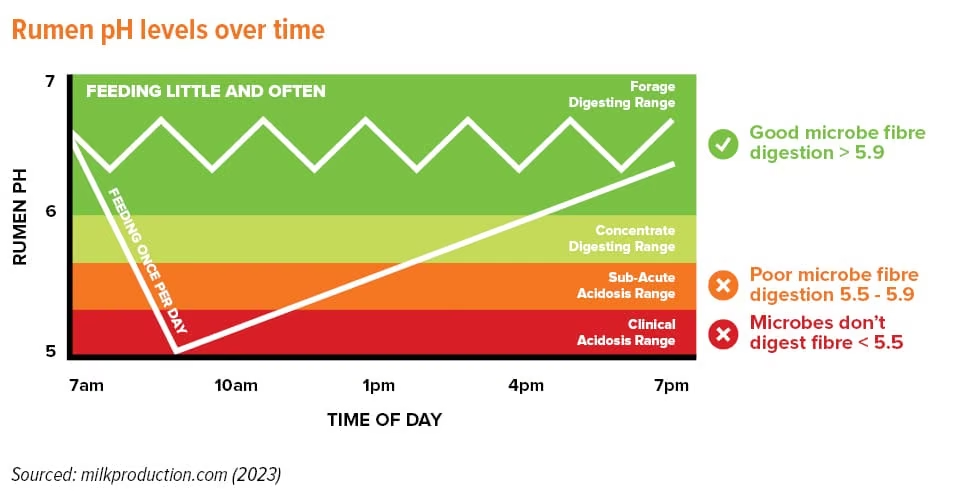
Forage digesting microbes operate most efficiently when the rumen pH is between 6 and 7. (Sourced: milkproduction.com, 2023)
An experiment showed that when livestock are grazing dry pasture, the supplement requirement through the “little and often” system was 45% less than trail feeding every second day.
Please note that to achieve similar results, livestock must have access to enough dry pasture to keep their rumens full. If pasture is not available, livestock need to be provided with forages such as hay, straw, or silage to achieve similar results. Advantage Feeders hay feeders can provide systems to deliver these feeds with minimal feed waste.
Source: Leaver experiment available at www.advantagefeeders.com
The Leaver experiment showed that 45% less feed could be fed with the little and often system of the Advantage Feeders 3-way Restriction System
This should be broken down into two components: the starting time and the finishing time.
Commencement. It starts when the quality of feed on offer does not meet your production goals:
Completion. When there is enough new season pasture growth to meet production objectives: a common supplementary feeding period can be 150 days, starting in January for the temperate areas of Australia, and 180 days, starting in May for the sub-tropical parts of Australia.*
Please note:
*Disclaimer: This information is intended as a general guide and may be applied in other regions; however, timing, seasonal reference points, and pasture growth stages will vary depending on local climate, conditions, and farming systems. The above studies were conducted in Australia.
It is a complex evaluation. Livestock have requirements for energy, protein, minerals, and vitamins based on whether their objective is to put on weight, hold weight, or lose weight. Other factors include the pregnancy and lactation status of an animal and the quality and availability of paddock feed on offer. Consult a livestock nutritionist or farm consultant for expert advice.
Generally, energy is the limiting factor in a diet, and cost-effective sources are typically cereal grains and pelleted feeds.
How to work out the price of energy per MJ within different feed options: Price of energy (per MJ) = Price (per tonne as fed) / Energy density (MJ/kg of dry matter) / Dry Matter (%) / 1000
Examples:
In these examples, the sample of barley has the most cost-effective energy, followed closely by wheat.
Please note that the pellets could be formulated to provide the other requirements of the livestock: protein, minerals and vitamins.
The cheapest source of energy can often be the best feed to provide livestock
Any animal with a rumen offers a high return on investment. Any class of livestock that is grazing pasture and not meeting requirements to obtain production goals can be supplemented with the “little and often” system to achieve a profitable result.
There is a wide range in quantity required to be fed to livestock based on whether the objective for livestock is to put on weight, hold weight, or lose weight. Other factors include the pregnancy and lactation status of an animal and the quality and availability of paddock feed. Consult a livestock nutritionist or farm consultant for expert advice.
Common feeding ranges:
The main factor that influences the number of livestock per feeder is the quantity of dry feed available to livestock. When livestock can achieve rumen fill, 200 sheep per feeder and 40 cattle per feeder is a general recommendation. When livestock don’t have access to enough dry pasture or forage, they will visit the feeder more frequently and the recommended livestock per feeder will reduce.
Like all applications, the number of livestock per feeder can be increased, but it increases the risk of uneven consumption because there is more competition for trough space. This increase in risk requires more oversight and management to identify potential unevenness in feed consumption.
Experiment livestocking rates per feeder:

Please note: some smaller model feeders have different recommendations. Please view the specific product pages for more information.
Recommend 200 sheep per feeder / Recommend 40 cattle per feeder
Want to calculate the return on investment from dry feed supplementation? advantagefeeders.com

(Cereal grains / 4mm pellets / 6mm pellets — please note this is a guide only)
There are a number of factors that influence the minimum consumption achieved with the 3-way Restriction System. For this application, the most important two factors are:
Cereal grains are frequently used in this supplementary feeding application. If livestock don’t have sufficient training to the feeder and gorge the supplement, this can lead to acidosis and potentially, be fatal.
Acidosis issues can be avoided if untrained livestock are provided a safe feed, such as high-fibre pellets, in an ad-lib setting to encourage and reward their feeding behaviour at the feeder. Once feeding behaviour is consistent, the ration can transition to the cereal grain ration. While this process comes at a cost, time and time again, it has proven to have great results with little cost and minimal rumen upsets.
For the full explanation, see page our User Manual, which can be downloaded from our website.
Get the most out of your feeders year-round, for the best outcomes in every season. The ration control of our 3-Way Restriction System allows you to maximise your pasture, fodder and supplement conversion all year: