

Winter pasture growth rates in most areas are slow, which makes it challenging to carry enough stock through this period. The primary objective of creep feeding is to promote early rumen development in infant calves and lambs, enabling them to convert pasture, other forages, and supplements into nutrients they can utilise. They are not born with this ability.
As pasture is the most cost-effective feed source, once the rumen is developed, livestock can absorb nutrients from this feed source, leading to prompt growth in a cost-effective manner. Done correctly, supporting pre-ruminants to make an early transition to becoming ruminants is a very profitable exercise.
Infant ruminants are born as pre-ruminants with undeveloped and sterile rumens. Within a few days of birth, the young pre-ruminant begins to develop a population of microbes. The quantity and types of bacteria are determined by the environment and types of solid feed the animal eats.
When solid feed and water enter the rumen, the anaerobic (absence of oxygen) environment provides a perfect place for bacteria to grow, digest, and utilise the feed consumed. As these bacteria grow and metabolise nutrients, they produce volatile fatty acids. The primary volatile fatty acids produced in the rumen are acetic, propionic, and butyric acids. Suitable creep feed rations contain carbohydrates in the form of starch. The bacteria that digest starch produce large amounts of propionic and butyric acids.
When feeds high in fibre are fermented, the primary end product is acetic acid.
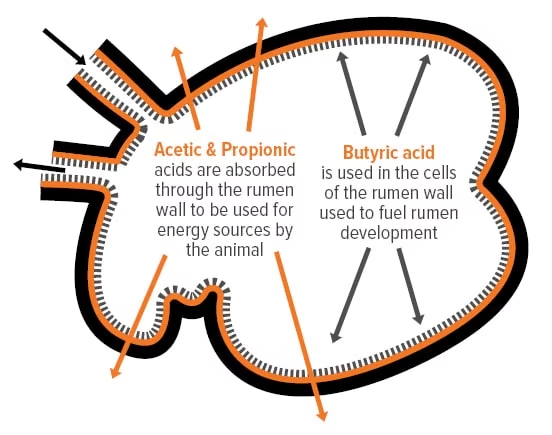
Acetic and propionic acids are absorbed through the rumen wall, transported in the blood, and converted in the liver into energy metabolites for the lamb or calf.
Butyric acid is not absorbed in the same way; instead, it is metabolised directly by rumen wall cells and used as an energy source for rumen tissue development. (Source: Heinrich J, 2019, Penn State University)
Therefore, butyric acid primarily drives rumen wall growth, while acetic and propionic acids mainly supply energy to the animal, with only a smaller portion supporting rumen development.
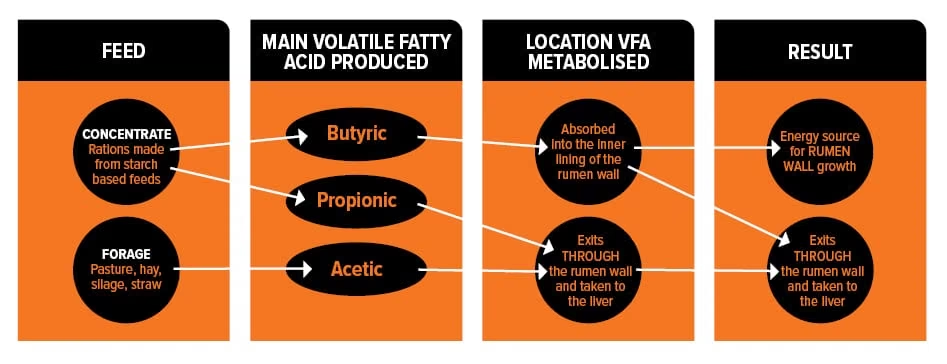
Butyric acid is the game changer. It provides energy for growth of the rumen wall. High starch feeds need to be provided to enable a fast transition for pre-ruminants.
It is common for creep feeding to lead to 20-25% faster growth!
The internal surface of a developed rumen is covered with tiny projections, papillae, which increase the surface area of the rumen and allow better absorption of digested nutrients. The image above shows the rumens of three different calves at the age of 6 weeks that have been fed three different rations (1. Fed milk only, 2. Fed milk and hay, 3. Fed milk and grain).
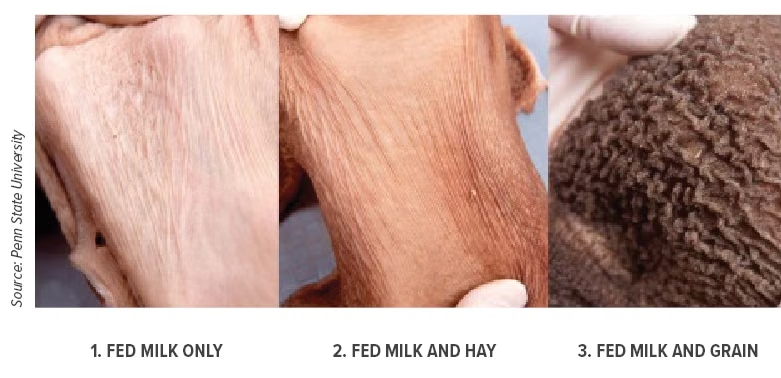
Fig 3 shows the dramatic change to the productive capacity of the rumen wall because of adding grain to the diet of a young calf. (Source: Penn State University)
Experiments have shown the additional growth rates of creep feeding (when the ration is no more than 200g/0.4lb per day for lambs and 800g/1.8lb per day for calves) compared to young livestock that weren’t creep fed:
Note: Feed conversion also depends on the genetics of the livestock and other available feeds.
Visit our website for all full trial results.
There are many factors that go into choosing the best creep feed ration. Consult a livestock nutritionist or farm consultant for expert advice.
There are however, two characteristics that all creep feeds require:
It is common for creep feeding to finish at weaning. Rumen development can be achieved before weaning; however, the high efficiency of feed conversion commonly achieved before weaning means it is often quite profitable to continue creep feeding until weaning.
It is often most practical to start creep feeding 2 weeks after the median lambing/calving date in a mob.
The sooner after birth, the faster the transformation of the rumen. However, if the feed offered to young livestock isn’t consumed quickly enough, the ration in the feed access area can become stale and unattractive, reducing feed intake. Balancing these two countering factors, it is often best to introduce creep feeders to lambs when the median age of lambs and calves is 2 weeks.
Note: If maternal livestock are being supplementary fed with feeders for a period of time into lactation, a compromise is often made to start creep feeding later than explained above, once the maternal livestock can stop being fed.
See the Training young livestock to consume starch diets at a young age section of this document.
Without creep feeding, the rumen will slowly develop. If creep feeding commences close to weaning (example: from 10 weeks of age for lambs and 20 weeks of age for calves), adding grain to the diet in an ad-lib amount can cause acidosis.
Newborn lambs and calves begin life with a sterile rumen that cannot initially convert feed into volatile fatty acids and lead to the potential of acidosis. If starch-based feeds are offered to very young stock, their rumen microflora is accustomed to this feed and it significantly reduces the risk of acidosis. It is best to commence creep feeding when lambs and calves are 2 weeks of age.
Pre-ruminates begin life with a sterile rumen that avoids issues with feeding starch based feed.
Pre-ruminant lambs and calves should be offered an ad-lib ration. The Upper and Lower Adjuster should each be set at a minimum of position 6. The Adjuster Guard should not be used and should be placed in its storage location under the weather shield, or under the unit if the creep gates block the slot on the weather shield.
Depending on the flow of the feed, the Upper and Lower Adjuster can be opened further; however, avoid feed continuously flowing into the trough. Livestock prefer fresh feed, so if the trough fills up too much and the livestock don’t consume it, the feed can be wasted.

Pasture is one of the cheapest sources of feed. To ensure profit is not reduced from creep feeding, ensure that livestock do not excessively substitute relatively expensive feed (the creep feed ration) for their cheap feed source (pasture).
There is a lack of scientific experimentation specifying the varying results gained from feeding a range of creep feed quantities.
Our experiments and the results from clients who are creep feeding have consistently shown profitable results when creep fed:
Want to calculate the profit from creep feeding? advantagefeeders.com
It is recommended to stock 200 lambs or 50 calves per feeder. Like all applications, the number of livestock per feeder can be increased, but this increases the risk of uneven consumption because there is more competition for trough space. The increased risk requires more oversight/management to identify potential unevenness in feed consumption.
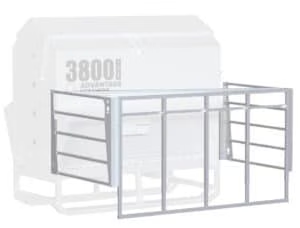
200 lambs per creep panel setup / 50 calves per creep gate setup
The methods of training pre-ruminants vary depending on the varying scenarios that are facing the maternal livestock.
Monitoring feed intake of pre-ruminants that are being creep fed is very important because their intake can increase rapidly over a short period when lambs are approximately 8 weeks of age and calves are approximately 16 weeks of age.
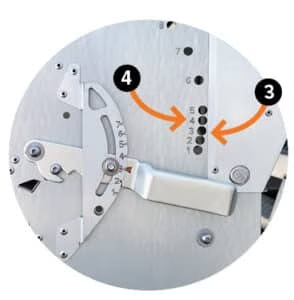
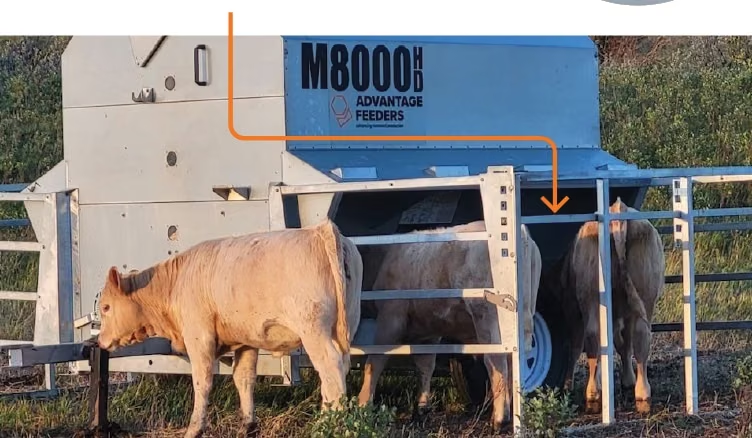
The Creep Panels should start in Position 3. Once lambs start tugging to get their heads out from under the Creep Panel, open this to Position 4. This typically commences when lambs are approximately 10 weeks of age. Once tugging starts, there is generally a fortnight before they can no longer tug hard enough to get their head out.
The horizontal bar on the Creep Gates should be positioned at the height of the back of the largest calf. As calves increase in size, move the bar up.
Pasture is one of the cheapest sources of feed. To ensure profit is not reduced from creep feeding, ensure that livestock do not excessively substitute relatively expensive feed (the creep feed ration) for their cheap feedsource (pasture).There is a lack of scientific experimentation specifying the varying results gained from feeding a range of creep feed quantities. Our experiments and the results from clients who are creep feeding have consistently shown profitable results when creep fed:
An average of 150–200g / 0.33lb–0.44lb per day for lambs over the whole creep feeding period. Another method is to offer ad-lib creep feed until they consume 200g / 0.44lb per day, then restrict intake to that level until weaning. It is common for this to occur when lambs are 6–8 weeks of age.
An average of 600–800g / 1lb, 3oz – 1lb, 7oz per day for calves over the whole creep feeding period. Another method is to offer ad-lib creep feed until they consume 800g / 1lb, 3oz per day, then restrict intake to that level until weaning. It is common for this to occur when calves are 12–16 weeks of age.
Monitoring feed intake of pre-ruminants that are being creep fed is very important because their intake can increase rapidly over a short period when lambs are approximately 8 weeks of age and calves are approximately 16 weeks of age.

advantagefeeders.com
It is recommended to stock 200 lambs or 50 calves per feeder. Like all applications, the number of livestock per feeder can be increased, but this increases the risk of uneven consumption because there is more competition for trough space. The increased risk requires more oversight/management to identify potential unevenness in feed consumption.
200 lambs per creep panel setup
50 calves per creep gate setup

The methods of training pre-ruminants vary depending on the varying scenarios that are facing the maternal livestock.